
Moisture on the job site is a big problem. Why? Well, moisture can compromise soil stability, lead to costly failures, and destroy insulation. This is why understanding water resistance in materials like Geofoam is critical.
EPS Geofoam has been used in everything from large stadiums to highways and has become a dependable choice for lightweight fill and insulation in civil engineering.
In this blog, we will answer the question: Does geofoam absorb water? So, let’s talk more about Geofoam, what being waterproof means, and when it can be used.
What is Geofoam?
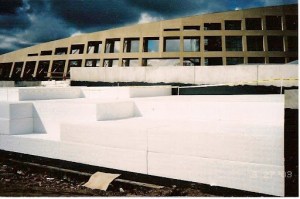
To start off, let’s address what Geofoam actually is. Geofoam is made from Expanded Polystyrene (EPS), which is a rigid, closed-cell material that is both strong and lightweight. The list of EPS Geofoam applications is long. Too long to list everything, in fact. Some of the applications worthy of mentioning are:
- Bridge abutments
- Vegetative roofs
- Swimming pools
- Landscape features
- Stadium seating
- Theater and entertainment
- Levees
- Airport runways
EPS geofoam can be cut and shaped on-site with ease, allowing for the creation of unique architectural and landscape profiles such as waterfalls, arches, and terraced contours. One of the key advantages of using EPS geofoam for vegetative roof systems is the added insulation value it provides. EPS is an efficient thermal insulator and has long been trusted in building construction for its energy-saving benefits and durability.
Understanding Water Resistance vs. Waterproof
Now, it’s time to tackle some terminology. Sometimes, people use the terms water resistant and waterproof interchangeably. However, they are not the same things. What do they mean? Well, if something is water resistant, it can repel water to a degree without absorbing much. On the other hand, waterproof means water cannot get in at all. So, if something is waterproof, it is impermeable or impervious and does not allow water under any circumstances. By understanding what each of these terms mean, we can better explain how Geofoam interacts with moisture.
How Geofoam Handles Moisture
The short answer is that EPS is moisture resistant, not waterproof. EPS has a closed-cell structure that limits water absorption. When used in well-drained conditions, no change in EPS geofoam weight is expected over time. However, a slight weight increase in the weight of EPS geofoam can be expected over time due to water absorption if installed in a submerged application.
A permeance or “perm” rating is a standard measure of the water vapor permeability of a material. Unlike the R-value, in which the higher the number, the better, a material with a lower perm rating is better at retarding movement of water vapor. Resistance to moisture absorption is important because water is an excellent conductor of heat.
 The perm rating for EPS insulation is 5.0, making it a Class III permeable vapor retarder. But that rating may be misleading. A material’s ability to not only resist moisture but to readily release any moisture it does absorb, referred to as “drying potential,” is also an important factor to consider in an insulation material. The drying potential for thermal insulation is critical to maintaining the structure’s thermal resistance. The perm rating may not be indicative of the long-term results.
For example, in a side-by-side test of EPS and its “cousin,” XPS, or extruded polystyrene, both insulations were used below-grade on a building foundation. After 15 years, both EPS and XPS were removed and tested using the ASTM C1512 test (Standard Test Method for Characterizing the Effect of Exposure to Environmental Cycling on Thermal Performance of Insulation Products). The EPS insulation had a moisture content of 4.8%, compared to an 18.9% moisture content for the XPS insulation. After a drying time of 30 days, the moisture level of the EPS insulation dropped to 0.7% versus 15.7% for the XPS insulation. EPS exhibits a higher R-value over moist-dry cycles, most often seen in below-grade applications, outperforming XPS insulation and providing a long-term R-value to the project.
ASTM testing (like D2842) proves minimal absorption rates-often <2-4% by volume, even after long exposure.
When to Use EPS Geofoam for Moisture-Prone Projects?
So, when should you use EPS Geofoam for projects with moisture? Well, EPS geofoam is a suitable choice for moisture-prone projects due to its low water absorption and durability, making it ideal for applications like retaining walls, foundations, and below-grade construction. Its lightweight nature also offers benefits in areas prone to seismic activity or where minimizing load is crucial.
To close, EPS geofoam is water resistant, not waterproof. It is an excellent product choice when confronting moisture on the job site. Even when immersed in water, it absorbs only a small amount of water.
Looking to learn more about Geofoam solutions? CMI Insulation is a trusted expert in geofoam solutions. Call us today at (801) 352-9800 to learn more.
