
Post Summary: You can paint vapor barrier facing, including FSK, PSK, and ASJ insulation, but it requires extensive surface preparation, seam and hole repairs, paint adhesion testing, and careful application. Painting insulation facings after installation can add labor costs, downtime, and uncertainty around long-term adhesion and fire performance. For metal building projects that need a darker finish, specifying black vapor barrier facing from the start is typically the more affordable, lower-risk alternative to painting white facing later.
You finally got your metal building insulated. The facing looks clean, bright and professional, exactly the kind of finish that makes a workspace feel usable instead of like a dim metal box. Then someone walks through and says the white facing has to go. Maybe it clashes with a new color scheme, maybe a client is touring the facility and the bright white reflects glare under the lights, or maybe leadership just wants a darker, more industrial look. So you start pricing out paint.
Here’s what actually happens next: painting a vapor barrier facing after installation is far more involved and far more expensive than most building owners expect. It doesn’t have to be that way. If you know before installation that you want a darker finish, choosing a black facing from the start is almost always the smarter and cheaper path.
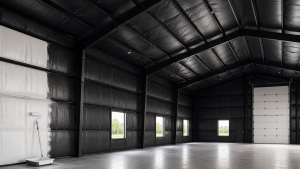
The Hidden Cost of Painting After the Fact
Most metal building insulation comes with a white or silver facing, such as FSK (foil-scrim-kraft), PSK (poly-scrim-kraft) or ASJ (all-service jacket). These facings double as your vapor barrier, so they’re not just cosmetic. Anything you do to them has to be done carefully, or you risk compromising the very barrier that’s protecting your insulation from moisture and rust.
According to the manufacturer Lamtec’s technical guidance on how to paint insulation facing, the process isn’t a simple roll-and-go job. FSK, PSK and ASJ facings can be painted with water-based, oil-based or solvent-based paints. But the facing has to be wiped clean and free of contamination first. Every seam needs to be sealed, and any holes in the facing must be repaired before a single coat goes on. That’s already a labor-intensive prep job across thousands of square feet of overhead facing.
It gets more demanding from there. Lamtec recommends testing the specific paint for adhesion and flexibility before committing to it, which means brush-applying test coats and letting them cure for a day or two. Then, check whether the paint holds up to masking tape adhesion tests and a flexibility test, where the painted sample is crumpled into a ball and unrolled to see if the paint cracks or flakes. If your installer skips this step, you’re gambling on adhesion across an entire building, which is a costly mistake to discover after the fact. There’s also a performance trade-off most people don’t think to ask about. Painting can affect the fire performance of the faced insulation, and because paint formulations vary so widely, the manufacturer makes no guarantees about how the facing performs once it’s been painted. That’s a real risk to take on for a finish you could have chosen from day one.
The Real Cost: Paint vs. Black Facing
Once you add up labor, paint, testing and the risk of compromising your vapor barrier, painting white facing after installation is quietly draining your budget compared to simply ordering black facing upfront.
- Painting after installation: surface prep across the entire facing, seam sealing, hole repair, paint testing for adhesion and flexibility, multiple coats, plus labor for working overhead in a finished building.
- Black facing from CMI: the same protective vapor barrier performance you’d get from white FSK, PSK or ASJ, manufactured in black, with zero on-site painting, zero downtime and no risk of compromising the seal.
If you’re already weighing whether to paint vapor barrier facing, it’s worth comparing that labor and material cost against simply specifying black facing at the time of install or retrofit. In almost every case we’ve seen, the math favors black facing.
So, Can You Paint FSK Facing? Yes, But Should You?
Can you paint FSK facing? Technically, yes, the manufacturer’s own guidance confirms it’s possible. The same goes for whether you paint PSK facing or paint ASJ insulation; both can be coated using the same prep-test-apply process. But “possible” and “practical” are two different things.
Painting insulation facings after they’re already installed means working around existing structure, doing the job overhead and accepting some uncertainty about long-term adhesion and fire performance.
This is exactly the kind of “do it right the first time” decision we talk about with every retrofit project. If aesthetics matter to you, and we know they do, our team can spec a black facing into your new install or retrofit insulation system so you get the look you want without ever picking up a paint brush.
It’s the same low-disruption approach we use for every CMI retrofit. No removing exterior panels, no shutting down operations and no compromise on the vapor barrier doing its actual job of protecting your structure from moisture and rust.
The Smart Investment
A metal building’s insulation system is only as good as its weakest link, and an improperly painted facing can become exactly that. Choosing black facing at the outset gives you the finish you want without touching the vapor barrier’s integrity, without extra labor costs and without the guesswork of paint adhesion testing.
It’s a smaller decision than most of the structural choices you make for your building, but it’s a smart investment that saves real money down the line. Ready to talk through facing color options for your next project or retrofit? Reach out to our team and we’ll help you spec the right system the first time.
FAQs – Frequently Asked Questions
Is black facing as effective a vapor barrier as white facing?
Yes. Facing color doesn’t change the vapor barrier performance. Black FSK, PSK and ASJ facings are manufactured with the same foil, scrim and laminate construction as white facings, so they provide the same moisture protection.
Does painting insulation facing void the manufacturer’s warranty?
It depends on the manufacturer and the paint used, since field-applied paint isn’t something the manufacturer controls or tests for your specific product. That’s part of why choosing black facing upfront is generally the lower-risk option.
What kind of paint works best if I do decide to paint a facing?
Interior water-based acrylic paints are the most commonly used option for FSK and PSK facings, but any paint should be tested on a sample piece for adhesion and flexibility before it’s applied across an entire building.
Will painting the facing affect its fire rating?
It can. Paint coatings have the potential to change how the facing performs in a fire, which is one more reason to weigh that risk against simply ordering the color you want from the start.
