
Post Summary: Retrofit insulation is often the smarter long-term investment for metal buildings with aging, compressed, or underperforming insulation. This blog explains how retrofit systems can improve R-value, reduce energy costs, protect against condensation and corrosion, and refresh the building interior without the high cost, downtime, and disruption of a full insulation tear-out.
Does your metal building feel like an oven in the summer and an icebox in the winter? If you’ve been dealing with sky-high energy bills, dripping ceilings or insulation that’s visibly sagging and falling apart, you already know something has to change. The real question is: do you rip everything out and start from scratch or is there a smarter path forward?
When it comes to metal building insulation replacement, most building owners assume the only option is a full insulation tear-out in a metal building. That’s a messy, expensive and disruptive process. Here’s what actually happens when you dig into the numbers: in the vast majority of cases, retrofit insulation for a metal building delivers better value, faster ROI and far less headache. Let’s break it down.
The Hidden Cost of Doing Nothing (Or Doing Too Much)
Old, degraded insulation isn’t just uncomfortable, it’s quietly draining your budget. Failing insulation in a metal building creates a chain reaction of problems:
- Thermal bridging through steel purlins and girts drives up heating and cooling costs year-round. Steel conducts heat roughly 300-400 times faster than wood, meaning every exposed metal frame member is essentially a highway for energy loss.
- A compromised vapor barrier allows moisture to accumulate inside wall and roof cavities, accelerating rust and corrosion on your structural panels.
- Your HVAC system works overtime trying to compensate, increasing wear and shortening its lifespan.
- The interior of your building stays dark, dingy and uncomfortable, reducing productivity and property value.
The instinct to fully replace old insulation in a metal building makes sense on the surface. But before you go that route, it’s worth understanding exactly what you’re signing up for.

What a Full Tear-Out Actually Involves
A full insulation tear-out in a metal building means removing every panel liner, pulling out all the old fiberglass batts, disposing of the material, and reinstalling everything from scratch. In practice, that means:
- Shutting down operations for days or even weeks, depending on building size
- Hiring a large crew for both demolition and reinstallation
- Significant disposal costs for the old material
- Potential damage to exterior panels or structural components during removal
- Substantially higher labor and material costs compared to a retrofit
For metal building insulation replacement via full tear-out, costs can run significantly higher. Not just in materials, but in lost productivity and operational downtime. For an active warehouse, manufacturing facility or commercial building, that’s a real number that belongs in your cost analysis.
Is it ever the right call? Yes, when insulation is severely damaged, soaked with moisture or contaminated. But for the majority of buildings with compressed, aged or underperforming insulation, it’s an expensive path to a problem that has a better solution.
The Case for Retrofit: Smarter, Faster and More Cost-Effective
A retrofit insulation system works by installing new high-performance fiberglass insulation over or in place of the existing material, without removing exterior panels, tearing out liners or shutting down your building. It’s a fundamentally different approach and the advantages are significant. Here’s how retrofit insulation for a metal building works:
- Step: Assess the existing insulation. We evaluate what’s there, where R-value has been lost and where moisture may have compromised the vapor barrier.
- Step: Install new insulation between purlins. CMI’s proprietary clip-and-wire system allows new laminated fiberglass batts to be installed cleanly and securely without the need for a large crew or exterior panel removal.
- Step: New facing goes up. The bright, clean, professional facing that CMI installs, transforms the interior from dark and dingy to bright and usable. Many building owners are genuinely surprised by how much the interior changes.
- Step: Operations continue. In most cases, your building stays open and functional throughout the entire process.
For a steel building insulation retrofit, this approach is simply more practical. It addresses the real performance issues, thermal bridging, vapor barrier failure, R-value loss, without the cost and disruption of a full replacement.
Retrofit vs. Replace Insulation: A Side-by-Side Look
When you’re weighing retrofit vs. replace insulation for your metal building, the comparison looks something like this:
| Retrofit System | Full Replacement | |
| Downtime | Minimal to none | Days to weeks |
| Labor Cost | Low | High |
| Material Disposal | Not required | Significant |
| Disruption to Operations | Very low | Very high |
| Interior Finish | Bright, clean, professional | Dependent on new liner |
| R-Value Improvement | Substantial | Substantial |
| Best For | Most existing buildings | Severely damaged or contaminated insulation |
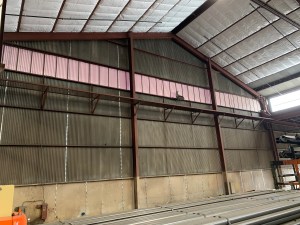
What Does Metal Building Insulation Retrofit Cost?
The metal building insulation retrofit cost varies based on building size, existing conditions and the R-value target you’re trying to hit. But it is consistently and significantly lower than a full tear-out. Here’s a general framework:
- Retrofit systems typically run $0.50-$1.50 per square foot for materials, with labor costs reduced by the ease of installation.
- Full tear-out and replacement can run 2-3 times higher when you factor in demolition labor, disposal, and reinstallation.
- Energy savings from improved insulation (particularly when you’re upgrading from compressed or failing batts to a properly installed high R-value system) can offset the retrofit cost within 2-5 years depending on your building’s size and energy usage.
That retrofit insulation ROI calculus is one of the most compelling arguments for the approach. You’re not just spending money. You’re making a smart investment that pays you back through lower utility bills, reduced HVAC maintenance and increased property value.
The Financial ROI: What You’re Really Investing In
Let’s talk numbers. Properly insulating a metal building can reduce heating and cooling costs by 20-40% annually. That range is cited across commercial metal building efficiency literature and it tracks with the physics. Steel conducts heat roughly 300-400 times faster than wood, so fixing the thermal envelope has an outsized impact compared to the same upgrade in a conventional structure. That’s the physics of heat transfer working in your favor. Beyond energy savings, well-insulated metal buildings also benefit from:
- Reduced HVAC wear: Systems that don’t run as hard, last longer
- Corrosion protection: A functioning vapor barrier stops the moisture cycle that leads to rust
- Increased property value: A clean, insulated interior is a tangible asset if you ever sell or lease the building
- Potential tax incentives: Energy efficiency upgrades may qualify for federal deductions or utility rebates under current programs
The retrofit insulation ROI timeline for most buildings sits between 2 and 5 years. After that, the savings are pure return.
A Retrofit System That Gets It Right the First Time
The best solution is the one that solves the actual problem without creating new ones. The details that make a retrofit succeed or fail are specific to steel construction. How insulation sits against purlins and girts determines whether thermal bridging is actually addressed or just covered over. How the vapor barrier is positioned determines whether moisture problems are solved or sealed in. How the facing is finished determines whether the interior ends up bright and usable or just slightly less dingy than before.
Getting those details right requires experience with metal buildings specifically, not construction in general. After 40 years working exclusively with pre-engineered steel structures, CMI’s retrofit insulation system was built around exactly these variables. Whether you need metal building insulation repair on a single section or a full steel building insulation retrofit from roof to walls, the right starting point is a system designed for the structure you actually have.
