
Post Summary: R-value measures how well insulation resists heat flow, while U-value measures heat transfer through a complete roof or wall assembly. In metal buildings, steel framing, fasteners and insulation compression can affect overall performance. Learn why both values matter and what to request when comparing insulation quotes.
A metal building can have thick insulation and still lose more heat than expected. That is because steel framing, roof panels, fasteners, purlins and girts all affect how heat moves through the building envelope. If you are comparing insulation quotes, understanding R-value vs. U-value helps you look beyond a product label and choose a system that performs as intended.
And the best part about it? It doesn’t even have to be complicated. R-value tells you how well an insulation material resists heat flow. U-value tells you how much heat moves through the complete roof or wall assembly. For metal buildings, both matter, but U-value often gives the clearer picture of real-world performance. But let’s take a closer look at the difference between R-value and U-value together.
What R-Value Measures
R-value measures resistance to heat flow. The higher the R-value, the better the insulation material resists heat moving through it.
For example, fiberglass insulation with a higher stated R-value generally slows heat transfer more effectively than a thinner fiberglass blanket. That is useful when comparing insulation products, but it is not the whole story for metal building insulation R-value.
A metal roof or wall includes more than insulation. It also includes metal panels, structural steel, insulation supports, purlins, girts, fasteners, air spaces and interior finishes. Each component affects total thermal performance.
What U-Value Measures
U-value, sometimes called U-factor, measures the rate at which heat passes through a complete assembly. In simple terms, it shows how the whole roof or wall performs once all materials and heat-loss paths are considered. With R-value vs. U-factor, remember this simple rule:
- Higher R-value is better because the material resists heat flow.
- Lower U-value is better because less heat flows through the assembly.
So, is a lower U-value better? Yes. A lower U-value indicates a more efficient roof or wall assembly because it allows less heat to transfer between indoors and outdoors.
Why Both Values Are Important in Metal Buildings
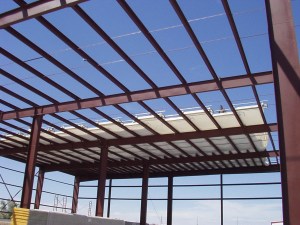
The biggest reason is thermal bridging in metal buildings. Steel conducts heat much more readily than fiberglass insulation. When steel components create a direct path through an insulated roof or wall, heat can bypass portions of the insulation.
A roof assembly may include high-R-value fiberglass between purlins, but the purlins and fasteners still conduct heat across the assembly. If the insulation system is not designed around those conditions, the actual assembly performance can fall short of what the insulation label alone suggests. This is why the difference between R-value and U-value matters so much for metal buildings:
| Value | What it measures | Better direction |
| R-value | Resistance to heat flow of an insulation material or layer | Higher is better |
| U-value/U-factor | Heat flow through the complete roof or wall assembly | Lower is better |
Two assemblies can use insulation with the same R-value, but have different U-factors. Differences in framing, insulation placement, panel type, fasteners and thermal blocks can all change how the full assembly performs.
Does Compressing Insulation Reduce R-Value
Yes, it does, and this is actually an important question, especially in steel buildings with limited space around purlins and roof panels.
Fiberglass insulation works by trapping air within its fibers. When it is compressed, those air pockets are reduced. That changes both the thickness and thermal performance of the insulation. A blanket designed for one cavity depth should not simply be forced into a shallower space.
Compression can also make installation more difficult around purlins, girts, braces and clips. The result may be uneven coverage, gaps and less predictable thermal performance. That is why a properly sized insulation system is a really smart investment.
At CMI, our metal building insulation solutions are designed for steel-building assemblies, with configurations intended to support thermal performance, energy-code needs and a bright, clean, professional interior finish.
R-Value vs. U-Value for Code Compliance
Energy codes may allow several compliance paths. Some projects follow prescriptive insulation R-value requirements. Others use a U-factor path that evaluates the full roof or wall assembly.
A U-factor approach can be especially useful when the framing layout, insulation configuration or building design does not align neatly with a standard prescriptive option. Rather than adding material simply to chase a nominal R-value, the project team can evaluate the assembly as it will actually be built.
That can help avoid overbuilding the insulation package, late plan-review changes and installation costs that are quietly draining your budget. CMI’s Energy Code Help can help builders and owners understand the insulation-system information needed for an energy-code submittal.
Which Value Should You Use?
The value you need depends on what you are trying to compare:
- Comparing insulation products or thicknesses? Focus on R-value.
- Comparing complete roof or wall systems? Focus on U-value or U-factor.
- Choosing insulation for a new metal building project? Review both values before making a decision.
For a reliable quote comparison, ask each supplier to provide the insulation’s nominal R-value, the intended assembly U-factor, insulation placement, system components, facing type and any assumptions about purlins, girts or thermal blocks. This gives you a clearer comparison than simply choosing the highest R-value on a proposal.
Note: The best system is not always the thickest one. It is the system that fits the structure, supports the required code path, installs correctly, helps manage heat flow and condensation, and protects your long-term operating budget.
At CMI, our team specializes in insulation for metal structures and can help you move from a confusing list of R-values to an assembly that makes sense for your roof, walls, location and budget. Explore our metal building insulation options or request energy-code guidance before selecting a system.
Frequently Asked Questions
What is the difference between R-value and U-value for metal building insulation?
R-value measures how well an insulation material resists heat flow. U-value measures how much heat passes through the entire roof or wall assembly, including insulation, steel framing, panels and fasteners.
Are U-value and U-factor the same thing?
Yes, they are. In building-energy discussions, U-value and U-factor are commonly used to describe the same measurement: the rate of heat flow through an assembly.
Is a higher R-value or a lower U-value better?
Both. A higher R-value is better for an insulation material because it resists heat flow. A lower U-value is better for a complete assembly because it allows less heat to pass through.
Can I calculate a metal roof’s U-value from the insulation’s R-value?
Not accurately from insulation R-value alone. A metal roof’s U-value also depends on steel framing, roof panels, fasteners, insulation placement, thermal blocks and other assembly details.
Why can two systems with the same insulation R-value have different U-factors?
They may have different framing layouts, insulation locations, panel types, fasteners or thermal-bridge conditions. Those details change how heat moves through the completed roof or wall.
How does fiberglass compression affect insulation performance?
Compression reduces insulation thickness and changes the air spaces that help fiberglass resist heat flow. Use insulation sized for the available cavity and assembly configuration rather than forcing a thicker blanket into too little space.
Which values should I request when comparing metal building insulation quotes?
Request the nominal insulation R-value, the assembly U-factor, installation configuration, insulation placement, facing details and assumptions about purlins, girts and thermal blocks.
