
Post Summary: Condensation in tubular steel buildings occurs when humid air meets cold metal surfaces. Properly designed insulation, sealed vapor-retarder facings, air sealing and humidity management work together to reduce moisture buildup. This guide explains how these measures help protect tube-frame garages, workshops and storage buildings, including options for retrofitting existing structures.
Does your garage or workshop drip on cold mornings even though nothing leaked? That’s tubular steel building condensation and it’s one of the most common, most misunderstood problems building owners run into.
Unlike a solid I-beam, tubular framing is hollow, which means steel building condensation can form inside the tube itself, quietly rusting the frame from the inside out. Here’s what actually happens, why it happens faster in tube-frame buildings and how insulation, vapor barriers, air sealing and ventilation work together to stop it.
Why Do Tubular Metal Buildings Sweat?
Condensation needs exactly two ingredients:
- Warm, moist air
- A surface cold enough to hit the dew point
Warm air simply holds more water than cold air. 1,000 cubic feet of air at 75°F can carry up to 1.4 pints of water, but the same volume at 45°F can hold only about 0.5 pints. When that warm, humid air touches a cold steel surface, it can’t hold onto the extra moisture anymore, and it releases it as condensation.
Tubular framing makes this worse in two ways. First, steel is a highly efficient heat conductor, so tube walls track the outdoor temperature closely. Cold outside means cold inside, fast.
Second, tubular members are spaced more tightly than deep I-beam framing, creating more surface area and more thermal bridging paths per square foot of wall or roof. Add in everyday moisture sources (unvented heaters, a wet vehicle pulled in from the rain, livestock or simply people working inside) and tubular metal building condensation becomes almost guaranteed without a plan to manage it.
The Hidden Costs of Uncontrolled Moisture
Left unmanaged, this is more than only an inconvenience:
- Structural damage: Moisture trapped inside a hollow tube corrodes the steel from within, where you can’t see it until it’s already a problem.
- Asset damage: Dripping condensation ruins tools, stored vehicles, feed or inventory sitting underneath it.
- Mold and pests: Persistent dampness invites mold, mildew and the pests that come with it.
- Falling insulation performance: Wet fiberglass can lose up to 40% of its rated R-value, which starts a cycle where the building gets colder, sweats more and loses even more performance.
Will Insulation With a Vapor Barrier Actually Stop Condensation?
Yes, by keeping the interior surface of the steel above the dew point in the first place. Properly fitted insulation for tubular steel buildings separates the conductive steel from the warm, moist interior air, so there’s no cold surface left for that moisture to condense on. The catch is that coverage has to be continuous. Any gap around a brace, a base channel or a poorly cut corner creates a cold spot. And cold spots are exactly where condensation shows up first.
This is why we build tubular metal building insulation systems around the actual framing dimensions of the structure, rather than a generic layout. This includes faced fiberglass sized to reach full loft in a 2×2 to 2×4 tube cavity without gaps or compression.
The Crucial Role of a Vapor Barrier
Insulation slows heat transfer, but it isn’t a moisture seal on its own, because that’s the job of the facing. A vapor barrier for tubular steel buildings doesn’t stop water vapor completely, but it dramatically slows the rate and volume that can pass through, which keeps moisture from working its way into the cavity and condensing out of sight.
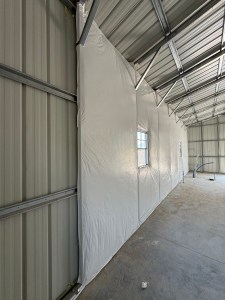
Our reinforced vapor barrier facings are engineered specifically for this. CMI’s most popular formaldehyde-free system is white, dust-free, and doubles as a moisture barrier for tubular steel buildings while giving the interior a bright, clean, professional finish instead of a dark, dingy shell.
Placement matters, too. The barrier belongs on the warm-in-winter side of the insulation, and every seam and penetration needs to be sealed. A gap here is often exactly where “concealed condensation” quietly forms between the insulation and the facing.
Air Sealing and Steel Building Ventilation
Insulation and a vapor barrier handle the surface temperature and moisture path, but steel building ventilation clears out the humidity load itself. Cross-ventilation, ridge vents or exhaust fans cycle out moist indoor air before it has a chance to find a cold spot. Pair that with sealing obvious air-infiltration points (doors, windows and base rails) and you’ve closed the loop. Insulation keeps surfaces warm, the vapor barrier slows moisture migration, air sealing stops uncontrolled infiltration, and ventilation removes what’s left.
That combination is real condensation control for tubular steel buildings, not any single product working alone. For more background on how heat and moisture move through a building envelope, the EPA’s moisture control guidance is a solid technical reference.
Retrofitting an Existing Tubular Building
You don’t need to strip exterior panels to fix an existing condensation problem. Our retrofit systems install faced fiberglass between the purlins from the interior, with every seam finished using true vapor-seal tape.
It’s actually a smart investment, because a properly sealed retrofit stops the moisture cycle without shutting your building down for weeks. A tube-frame building that stays dry protects the steel, the assets stored inside and the comfort of everyone using the space.
Ready to prevent condensation in tubular steel buildings on your property? Contact us and send us your building dimensions or photos, and our team will help you plan a system built for your actual structure.
Frequently Asked Questions
Why do tubular steel buildings develop condensation?
Tubular steel buildings develop condensation because the hollow steel tubing conducts outdoor temperatures quickly, and warm, moist indoor air condenses the moment it touches a surface that’s below the dew point.
How do you control moisture in a tubular steel building?
Moisture is best controlled through a layered approach: continuous insulation to keep surfaces warm, a sealed vapor barrier to slow moisture migration, air sealing at doors and penetrations, and adequate ventilation to remove excess indoor humidity.
How do you prevent condensation in a tubular steel building?
You can prevent condensation by keeping interior steel surfaces above the dew point with properly fitted insulation, sealing the vapor barrier at every seam and adding ventilation to reduce humidity buildup inside the building.
Does a tubular steel building need a vapor barrier?
Yes, a tubular steel building needs a vapor barrier. Without one, moisture can pass into the insulation and condense out of sight, which reduces R-value over time and corrodes the steel from within.
What insulation is best for condensation control in tubular steel buildings?
Faced fiberglass insulation with a continuous, sealed, reinforced vapor barrier is generally the most practical and cost-effective option for condensation control in most garages, workshops and barns.
